One Note for Every Letter
Your name is represented using the prefix alphabets printed on Indian ₹2 currency notes. Each letter of your name is matched with a corresponding prefix alphabet, turning your name into a unique currency collection.
How a serial number is built
Every note in the Indian currency system carries a serial number made of two parts: a prefix and the serial digits. For example, a For example, the ₹10 note below is numbered#8377;10 note may be numbered 47E 260779 — prefix 47E, then the six digits 260779.
| Denomination | Prefix format | Example |
|---|---|---|
| ₹1, ₹2, ₹5, ₹10, ₹20 | NNX | 47E |
| ₹50, ₹100, ₹200, ₹500 | NXX | 4AB |
N = a number, X = an alphabet.
Each letter of your name is matched with the alphabet in the prefix of a ₹2 note. Placed one after another, the notes spell your name — nothing is printed or added; the letters are already part of each note’s own serial number.
Why it is called “hidden”
To anyone else, these are simply ₹2 notes. Only the person who knows the name can read it in the prefixes.
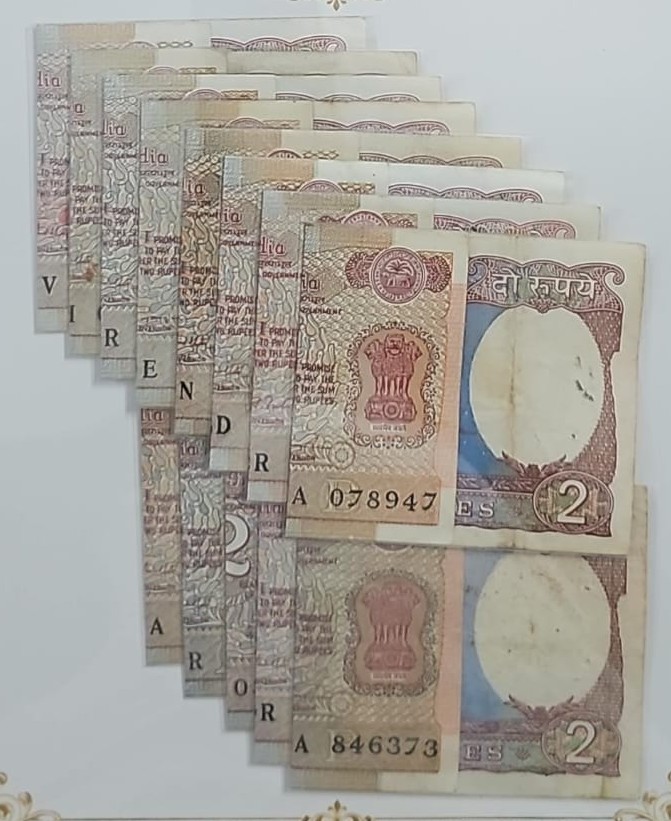
VIRENDRA ARORA
Thirteen genuine ₹2 notes — one for each letter. The prefix on each note, read in order, spells the full name.
The small numbers show the order of the notes.
Take the name
The name is split into letters: V-I-R-E-N-D-R-A and A-R-O-R-A — 13 letters, so 13 notes. Spaces between words need no note.
Match each letter
For every letter, we source a ₹2 note whose prefix alphabet is that same letter — a note with prefix V for V, I for I, and so on.
Arrange in order
The notes are arranged in the order of the name, so the prefix letters read down the edge as VIRENDRA and then ARORA, as in the photo above.
Good to know
- Every note is a genuine currency note issued by the Reserve Bank of India.
- A repeated letter needs its own note — R appears four times in VIRENDRA ARORA, so four R notes are used.
- Availability depends on note stock for each prefix alphabet.